Proposal
A proposal written in Markdown and built into one sealed Folio file: a cover with the Paus scene, who it is for and from, its date and how long it holds, and a stamped status while it is a draft; one section per heading; a rate card and stay prices worked out by the booking kernels, with other dates to try; a plan you…
quiet warm playful
Open the live demo
npx susegad add proposal
Stands on: Core, Core: components, Engine, Kernels: booking, Paus, Signature, Stamp, Tokens
The prompt
the prompt
A proposal you write in Markdown and send as one sealed file: it opens offline, prints cleanly, works out its own prices, and can be signed on screen or on paper.
The prompt
Build a recipe that turns a proposal written in Markdown into one self-contained, sealed HTML document. Read front matter for the title, who it is for and from, the date, the date it holds until, a status while it is a draft, the language, the register and the palette. Make a cover: a scene with the title and a line of byline laid over it, the draft status stamped across the picture's corner with <sg-stamp> (the words stay DOM text), and the meta set below like a letterhead in a definition list. Wrap each ## heading and what follows in its own section, with a pen-drawn rule above the heading and the section's number lettered by hand at the rule's end. Write the price tables at build time from the booking kernels, so the figures read and print with no script: the whole rate card by season (view=bands), and a stay night by night with before GST, GST on its own line, the total and the deposit, the word "provisional" wherever the house has not confirmed a figure, and a native disclosure to try other dates priced on the page by the same kernels. Make the plan an ordered list of steps on a rule, and with JavaScript add a native range above it that walks through the steps, marks the current one, quiets the ones done and says the step in words. Give every Markdown table a label on each cell from its column heading, so on a phone each row stacks into a small labelled card. For saying yes, turn the document's "Option 1, ..." paragraphs into native radios, then <sg-signature> for a drawn or typed signature, then a line that says whether it is signed and a button to print or save a signed copy. On paper, keep the radio circles and the signing line, add a line for the date, and print the drawn signature if there is one. Give it three registers: quiet is formal, with straight hairlines, no numerals and no lift; warm draws its rules by hand and letters its numerals; playful sets the numerals in small accent discs and tilts the stamp a little more, and never gets louder than the words.
Words to code
| When you say | Technique | What happens |
|---|---|---|
| one self-contained, sealed HTML document | Folio | build.mjs renders the Markdown with Folio's parser and the directive renderers, wraps it with proposalPage, and hands the page to packages/folio/build, which inlines and subsets everything, writes a strict Content-Security-Policy, seals the file with its SHA-256 and opens it with the network blocked. |
| holds until | front matter | valid-until: 2026-09-30 becomes <time datetime> in the meta, written the way people write dates. |
| the draft status stamped across the picture's corner | composition | status: internal review, not for sending becomes <sg-stamp tone="warning"> with "Internal review" as its headline. The stamp is scaled and tilted from its corner, so it never covers the words on the scene. |
one section per ## heading | structure | The rendered Markdown is split at each <h2 id>, and each part becomes <section aria-labelledby>, so the outline is real and print can keep a heading with what follows. |
| a pen-drawn rule | mask | A tapered ink stroke as an inline SVG, used as a CSS mask over --sg-rule-strong, so it takes the palette and the theme. |
| lettered by hand | counter | counter(section, decimal-leading-zero) in the hand face, at the right end of the rule. |
| at build time from the booking kernels | pure core | price-table.core.js runs the kernels' quote() in Node; ::price-table{from=kernels-booking view=bands} or arrival=... departure=... writes the finished <table>. <sg-price-table> only adds the try-other-dates form. |
| a native range that walks through the steps | native first | <input type="range"> with aria-valuetext set to "Step 2 of 8: ...", and a polite status line that speaks only when the reader moves it. |
| stacks into a small labelled card | container query | stackTables adds data-label from the column heading to each cell; under 34rem the table's rows become blocks and each label is shown with attr(data-label). |
| "Option 1, ..." paragraphs into native radios | directive | ::signature{name=... for=... option} finds the options after rendering and writes a <fieldset> of radios before <sg-signature>, whose first input must stay the typed name. options="A|B" names them instead. |
| a button to print or save a signed copy | progressive enhancement | The keep block is hidden in the markup; proposal.js shows it, says "Signed by Maria for option 2" when a signature and option are there, and calls print(). |
| keep the radio circles and the signing line | print CSS | Folio's print sheet hides inputs; the proposal brings back the radios as drawn circles and the typed-name input as the line to sign on, and adds "Date signed" under it. |
Accessibility
- Every live part has a plain reading: the tables are real tables with captions and row headers, the timeline is an ordered list, the signature is a labelled input, the options are a fieldset with a legend.
- The status is words in the stamp, not a picture of words.
- The scene's words sit in its reading panel, over a scrim; the scene is paused by its own button and still under reduced motion.
- Targets are at least 44 px tall: the options, the disclosure, the range and the buttons.
Credit
The Casa Exemplo proposal, and the letterheads, rate cards and signed estimates that Goan builders and hoteliers still send on paper. Tier: pan-Indian.
Write a proposal in Markdown and build it into one sealed .folio.html: it opens offline from a single file, works on a phone, prints cleanly on A4 or Letter, works out its own prices from the booking kernels, and can be signed on screen or on paper.
node packages/recipes/proposal/build.mjs path/to/proposal.md --pdf
node packages/folio/bin/folio.mjs verify path/to/<name>.folio.html
--pdf also prints <name>.A4.pdf and <name>.Letter.pdf. --register quiet|warm|playful overrides the front matter. --page-only writes the unsealed page beside the source, to look at it served (npm run serve). The sample proposal (examples/sample/proposal.md) is what the tests and npm run check build against.
Writing one
---
title: A booking site for the house at Aldona
for: The owners, Casa Aldona
from: The studio
date: November 2026
valid-until: 2026-12-15
status: internal review, not for sending
lang: en-IN
register: warm
palette: casa
---

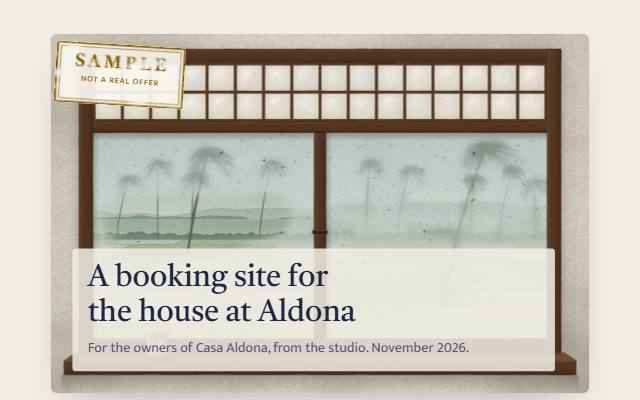
:::scene{name=paus}
# A booking site for the house at Aldona
For the owners of Casa Aldona, from the studio. November 2026.
:::

A line or two under the cover, before the first section.

## Your rate card

::price-table{from=kernels-booking view=bands}
::price-table{from=kernels-booking arrival=2026-11-16 departure=2026-11-20}

## What it costs

| What you get | Price |
|---|---|
| **Website.** Your own domain and an enquiry form. | ₹40,000 |

**Option 1, the website.** The site and the enquiry form. ₹40,000.

**Option 2, the website with the booking engine.** Everything in Option 1, and bookings. ₹95,000.

## The plan

:::timeline
1. **You choose an option.** Sign below, or reply with a message.
2. **The site goes live.** Rooms, rates and enquiries.
:::

## Saying yes

::signature{name="The owners" for="Casa Aldona" option}| Part | How |
|---|---|
| Cover | A :::scene before the first ## becomes the cover, with its heading over it. Without one, the title is set as a plain heading. |
| Meta | for, from, date and valid-until (YYYY-MM-DD) in the front matter, set under the cover. |
| Status | status: while it is a draft. The part before the first comma is stamped large. Take it out to send. |
| Sections | One per ##. Keep ### for parts of a section. |
| Rate card | ::price-table{from=kernels-booking view=bands}: every season, weekday and weekend, shortest stay. |
| A stay | ::price-table{from=kernels-booking arrival=... departure=... guests=2}: night by night, GST on its own line, the total, the deposit. Readers can try other dates. |
| Plan | :::timeline with 1. **Title.** What happens lines, or - when: what. |
| Scope, costs, who does what | Plain Markdown tables. On a phone each row stacks into a card labelled by the column headings. A first column with an empty heading names each row. |
| Notes | :::note for anything the reader must not miss. |
| Options | Paragraphs that open with bold **Option 1, ...**. |
| Signing | ::signature{name=... for=... option}; required makes the option and the signature required; options="A|B" names the choices yourself. |
The words the page adds (For, From, Holds until, the keep button) are in proposal.core.js, and the tables' words in price-table.core.js.
Registers
- Quiet: formal. Straight hairlines, no section numbers, no lift, the stamp square, the scene a still.
- Warm (the default): rules drawn with a pen, section numbers lettered by hand, notes on raised paper.
- Playful: the numbers in small accent discs, the rules in the accent, the stamp tilted a little more.
On paper
Folio's print sheet sets the page (the reader's own paper, A4 or Letter), the running title and page numbers, and the seal. The proposal keeps each heading with what follows, keeps table rows, notes and the signing block whole, prints the options as circles to tick, the typed-name input as a line to sign on, a "Date signed" line, and a drawn signature if there is one.
Without JavaScript
Everything reads: the cover's words, the tables (written at build time), the plan as a numbered list, the options as radios and a line to type a name. What needs a script (trying other dates, walking the plan, drawing a signature, the keep button) is simply not there.