Scenes Volume II
Plate XVII
An ant on the balcão floor
Mosaico · Goan Portuguese: the cement tiles on the floors of the old houses
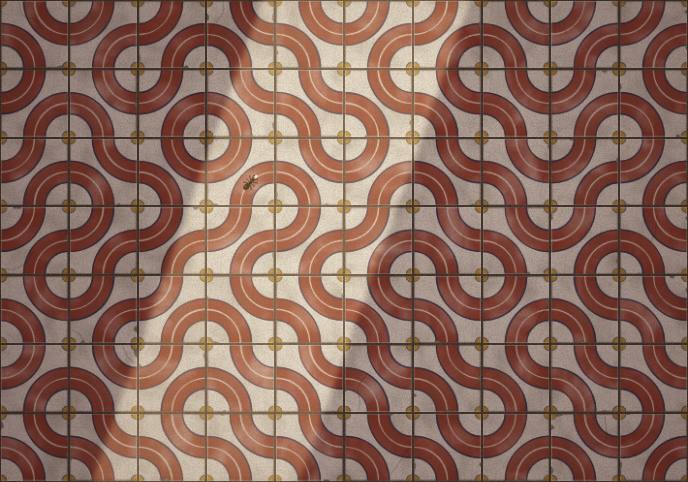
The floor is one tile design laid in two turns. Each tile carries two quarter-circle bands, and wherever tiles meet the bands join up, so the whole floor becomes a few long meandering ribbons. Now and then a tile turns and the ribbons re-route. An ant is walking the pale line down the middle of one ribbon, and it follows the new way when a tile turns under it. In playful, hover a tile to turn it and click to re-lay a patch; the arrow keys and Enter do the same.
The cement tiles (mosaicos) of Goa’s old houses, laid on the balcão and the floors inside, drawn with affection for their wear. The pattern is a Truchet tiling, a design two centuries older than the houses.
The prompt
the prompt
Draw the cement-tile floor of an old Goan house, seen from above, in canvas JavaScript with no image files. Lay a Truchet pattern: every tile has the same design, two quarter-circle bands joining the midpoints of neighbouring edges, and is set down in one of two turns, so the bands join across tiles into continuous meandering ribbons. Use a muted cement-tile palette: chalk ground, oxide red bands edged with indigo, a pale line down the middle of each band and an ochre dot where four tiles meet. Make it worn: uneven pigment, chipped edges, a hairline crack here and there, dark grout lines and paper grain. Let late light fall across it in the shape of a window with bars. Every few seconds, lift one tile and turn it by a quarter with a small overshoot as it settles, so the ribbons re-route. Put a small ant on the floor that walks the pale line along one ribbon from tile to tile, and follows the new route when a tile turns. Hovering a tile turns it, and a click re-lays the tiles around it in a ripple. Start by laying the floor tile by tile. Keep the floor and the ant a pure function of the seed, the time and the turns asked for, stepped and remembered, so the same inputs always give the same floor. Give it three registers: quiet is the laid floor with the ant at rest, warm turns a tile now and then while the ant walks, and playful answers the pointer and the arrow keys. Where words sit on the floor, no tile turns under them, and the ant turns round at their edge.
How the words become code
- two quarter-circle bands joining the midpoints of neighbouring edges
- tilings and grammarsThis is a Truchet tile. Because every band ends at the middle of an edge, and the neighbour’s band starts at the same point, bands always meet up, and one tile design in two turns makes long winding ribbons with no planning at all.
- walks the pale line along one ribbon from tile to tile
- tilings and grammarsThe ant only ever asks one question: which edge does this tile’s band lead to from the edge I came in by? The answer depends on whether the tile is turned, so when a tile turns, the ant’s route changes by itself.
- lift one tile and turn it by a quarter with a small overshoot
- easing and timelinesThe turn uses an ease that runs slightly past ninety degrees and comes back, so the tile seems to drop into place. It also shrinks a touch and casts a shadow while it moves, as if lifted. A turn takes 1 s, and a tile turns every 3.6 to 7.7 s in warm, 2.6 to 5.5 s in playful.
- Make it worn: uneven pigment, chipped edges, a hairline crack
- paper and grainEach tile is painted once into its own small image with seeded wear: smooth noise fades the pigment, a few edge chips show grout, and some tiles get a crack. The wear turns with the tile, as it would.
- Hovering a tile turns it, and a click re-lays the tiles around it in a ripple
- interactionThe pointer is mapped to a tile. Entering a new tile turns it once; a click turns the tiles within 1.6 tiles by one to three quarters, each starting 0.09 s later per tile of distance. Enter turns the tile under the keyboard hand.
- Start by laying the floor tile by tile
- seedsThe seed decides every tile’s turn and wear. The tiles are set down along a diagonal sweep, one every 25 ms, each dropping in with a small bounce; their images are painted a few milliseconds’ worth per frame in the same order.
- a pure function of the seed, the time and the turns asked for
- a pure modelThe floor steps forward in sixtieths of a second from zero and remembers where it got to, so a playing scene only pays for new steps. Turns asked for by a hand are a list with their moments, so the same seed and the same turns always give the same floor and the same ant.
- no tile turns under them, and the ant turns round at their edge
- calm zonesThe page reports where its text sits. Any tile under those boxes is left out of every turn, and to the ant its edge is a wall, as the skirting board is.
More of it
npx susegad add scene-mosaico