Date range
Arrival and departure over two native date inputs that submit without JavaScript.
quiet warm playful
Open the live demo
npx susegad add date-range
Stands on: Core, Core: components, Engine, Kernels: booking, Sound, Tokens
The prompt
the prompt
Two date inputs that submit on their own, and a calendar that knows the house.
The prompt
Build a stay picker as a light-DOM custom element, <sg-date-range>, that enhances two labelled native <input type="date"> fields for arrival and departure inside a fieldset, so the form works and validates without JavaScript through required, min and max. With JavaScript, add a two-month calendar under the inputs that writes into them and follows what is typed. Take availability and prices from pure booking kernels: a night is the night starting on its date, a stay occupies arrival up to departure, guests may leave on the morning others arrive, and no stay may cross a taken night. Make each month a keyboard grid like the WAI-ARIA date picker: one tab stop, arrows by day and week, Home and End to the week's ends, Page Up and Page Down by month and by year with Shift, Enter or Space to pick. Name every day in full with its price in Indian grouping or the reason it cannot be picked, and whether you can leave on it. When the kernels refuse a stay, set the departure input's custom validity to their reason so the form's own validation stops it. Give it three registers: quiet, hairline cells with outlined ends and a tinted stay; warm, the ends looped in hand-drawn ink with an underline under the nights between and a season ribbon above the calendar; playful, the same in bolder laterite ink. Keep the seasons in a plain table too, and draw the ink in full at once under reduced motion.
Words to code
| When you say | Technique | What happens |
|---|---|---|
| enhances two labelled native date inputs | native first | The inputs are the source of truth and what the form submits. The calendar only writes into them and reads from them, so a server can render a chosen stay and it looks the same either way. |
| guests may leave on the morning others arrive | turnover | classifyDay asks whether the previous night is free, so a day can be taken as a night and still be a departure. The grid marks it with a corner, and its name says "you can leave on this day". |
| no stay may cross a taken night | availability | After an arrival, the furthest departure is found by walking forward until a taken night; days beyond it are disabled but still reachable, so their reason can be heard. |
| a keyboard grid like the WAI-ARIA date picker | roving tabindex | Only one day button has tabindex="0". Keys move focus with a pure moveFocus; Page Down keeps the day of the month where it can (31 January goes to 28 February). The view follows focus. |
| set the departure input's custom validity to their reason | constraint validation | The kernels speak the portal's language ("The night of 2026-11-13 is already taken.", "The Christmas band has a 4-night minimum."). inWords recognises each reason by its shape and puts it in a guest's words ("The night of 13 November is already taken.", "Stays over Christmas week are at least 4 nights."), then setCustomValidity carries that into the browser's own validation bubble, so JavaScript and no-JavaScript rules meet in one place. |
| looped in hand-drawn ink | canvas overlay | A transparent canvas over the months draws a loop a little more than one turn round each end and an underline under each row of nights, then draws in along its length. It never takes a click. |
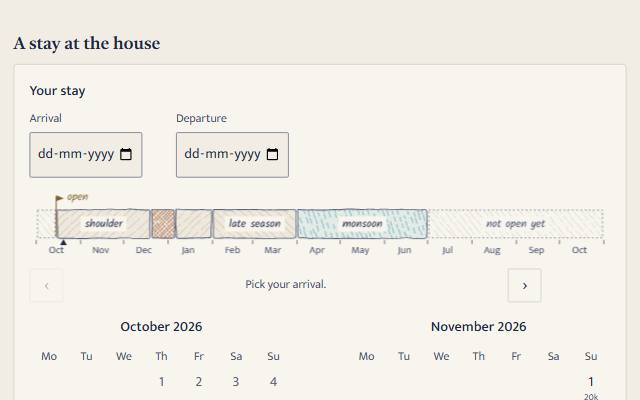
| a season ribbon above the calendar | texture | The year ahead split into runs by band: rain hatching for the monsoon, a crosshatch for Christmas week, dashed hatching for months not open yet, and the opening flag. The band under your pointer lights up. Token colours are resolved through the browser first, because a canvas cannot read light-dark(). |
| keep the seasons in a plain table too | text alternative | The ribbon is decoration; a details table lists each season, when it runs, its price range and its minimum stay. |
| takes enquiries before bookings open | open-from | The window guests pick from opens on this date (still after the notice period), while the ribbon keeps the rate card's opening flag. Limits the element set itself follow it; limits the page wrote stay. |
| a new rate card redraws | property setter | rates is a setter: prices, the ribbon, the season table and the element's own limits all follow it, with no need to touch blocks. |
<sg-date-range> asks for a stay: an arrival and a departure. Two native date inputs do the work, and submit with the form, with or without JavaScript. With it, a two-month calendar under the inputs writes into them, knows which nights are taken and which mornings you can leave as others arrive, and moves by keyboard like the WAI-ARIA date picker grid.
It reads availability and prices from the booking kernels (packages/kernels/booking/), so the calendar and the quote always agree.
Usage
<link rel="stylesheet" href="susegad/components/date-range/date-range.css">
<script type="module" src="susegad/components/date-range/date-range.js"></script>

<sg-date-range prices>
  <fieldset>
    <legend>Your stay</legend>
    <label>Arrival <input type="date" name="arrival" required min="2026-10-22" max="2027-06-30"></label>
    <label>Departure <input type="date" name="departure" required min="2026-10-23" max="2027-07-01"></label>
  </fieldset>
</sg-date-range>
Tell it what is already booked:
document.querySelector('sg-date-range').blocks = [
  { arrival: '2026-11-13', departure: '2026-11-16', kind: 'booking' }, // booking | hold | owner
];
Inside an <sg-form>, each input's note goes just after its label, never inside it. If the two labels sit side by side, wrap each in a block of its own (<div><label>Arrival <input type="date" …></label></div>) so a note wraps under its own date and never widens the input.
Set min and max on the inputs yourself so the no-JavaScript path has the window too; if you leave them out, the element fills them in from the rate card's booking window. Limits the element fills in follow open-from and a new rates; limits you wrote are never moved.
Take enquiries for any night from today, while bookings open later:
<sg-date-range prices open-from="2026-09-24"> … </sg-date-range>Every night after the notice period can be picked. The ribbon still flags the rate card's opening date, and the nights before it read as enquiries. open-from is a date rather than a mode, so the page says exactly when picking starts, a server can render it, and a test can pin it.
Attributes, properties and events
| Name | Kind | What it does |
|---|---|---|
prices | attribute | Show each free night's price (28k, 70k, 1.2L; the full figure in Indian grouping is in the day's name), the season ribbon (warm, playful) and a season table. Without it: dates only. |
today | attribute | An ISO date to treat as today, for demos and tests. Default: today in India. |
blocks | attribute or property | Taken nights as JSON, or an array: { arrival, departure, kind }. A booking's departure day is free for the next arrival. |
rates | property | The rate card. Default: RATES from the booking kernels. Setting it redraws the prices, the ribbon and the season table, and moves any input limits the element set itself. |
open-from | attribute | An ISO date: the first night guests can pick, when that is earlier (or later) than the rate card's window.openFrom. For a site that takes enquiries for any future night. The notice period still applies, and the ribbon keeps the rate card's opening flag, because that is when bookings open. |
window | property | The window guests pick from, read only: the rate card's, opening from open-from when set. |
selection | property | { arr, dep }, read only; the inputs are the source of truth. |
register | attribute | quiet, warm or playful. |
sg-pick | event | A day was picked: detail is { arr, dep }. |
sg-range | event | After every change: { arrival, departure, ok, reasons }. |
The inputs fire input and change when the calendar writes them, so a form or a recipe listens to them as it would to any input.
A day pick plays tick through the sound switch (packages/sound). Silent unless the switch is on and a gesture has already happened.
Registers
- Quiet: hairline cells; arrival and departure outlined, the nights between tinted. Nothing moves.
- Warm: the Casa calendar: arrival and departure looped in pool-blue ink, the nights between underlined, and a season ribbon above (monsoon rain, Christmas crosshatch, the opening flag, today). At phone width the band names move out of the bands into a two-column key under the months, each with its own swatch.
- Playful: the same in laterite ink, bolder and looser.
With reduced motion the ink is drawn in full at once.
Rules it keeps
- A night is the night starting on that date. A stay occupies
[arrival, departure). - You can arrive on any free night after the notice period; you can leave on a morning when others arrive (turnover), but not across a taken night.
- A stay the kernels refuse (a taken night typed into the inputs, a season's minimum nights, a stay that is too long) sets the departure input's validity with the reason, so the form's own validation stops it and says why. The reasons are also listed under the calendar, read out politely.
- The kernels keep the portal's wording, with ISO dates and rate-card terms.
inWords(indate-range.core.js) turns each one into a guest's words, fromSTRINGS.reasons: "The night of 13 November is already taken.", "Stays over Christmas week are at least 4 nights.", "Stays at this time of year are at least 3 nights." A reason it does not recognise passes through unchanged.
Accessibility
- Without JavaScript: two labelled date inputs in a fieldset with a legend, with
required,minandmax. - The calendar is a
gridper month, named by its month. One tab stop; arrows move by a day or a week, Home and End to the ends of the week, Page Up and Page Down by a month (Shift: a year), Enter or Space picks. - Each day's name says the date, your choice, whether it is free and its price, or why not, and whether you can leave on it. Days you cannot pick are
aria-disabledbut still reachable, so their reason can be heard. - The chosen days carry
aria-selected. A hint above the grid says what to do next and is read out as it changes. - Every night state has its own shape (a stroke for taken, a corner for departure-only, an outline for your ends), not only a colour. Forced colours are supported.
- The season information is a plain table (
Seasons and rates); the ribbon is its picture. - axe: zero violations in every register and theme. It lists colour contrast "to review by hand" in warm and playful because the ink canvas lies over the grid; the canvas is transparent apart from the ink round the cells.
Credit
The calendar, the ribbon and the rules come from the Casa Exemplo booking page and its portal kernels.